
8 Survey Questions Sample for Customer Satisfaction in 2025
Understanding your customers is the cornerstone of business growth, but how do you get the insights that truly matter? It begins with asking the right questions. Generic surveys often yield vague, unhelpful feedback, leaving you guessing about what your customers really think and need. This article provides a strategic breakdown of the 8 most effective survey questions sample for customer satisfaction, designed to give you clarity and direction.
We’ll move beyond simple templates to analyse the psychology behind each question type, offering tactical advice on when and how to use them to gather actionable data. You'll learn not just what to ask, but why a particular format works and how it translates into meaningful business intelligence.
By the end, you'll have a practical toolkit to craft surveys that not only measure satisfaction but also uncover opportunities to improve loyalty, reduce churn, and drive your business forward. We'll explore how to turn customer feedback into your most powerful growth engine. From Net Promoter Score to open-ended queries, you'll gain the confidence to design surveys that deliver real results. Ready to gather feedback that makes a difference? You can start building your perfect survey today with a platform like GoodKudos.
1. Net Promoter Score (NPS) Question Template
The Net Promoter Score (NPS) is a cornerstone of customer satisfaction measurement. It’s a powerful, straightforward metric designed to gauge customer loyalty with a single, crucial question: "On a scale of 0-10, how likely are you to recommend our company/product/service to a friend or colleague?" This is a key survey questions sample for customer satisfaction because of its simplicity and the deep insights it provides.
Based on their response, customers are categorised into three distinct groups: Promoters (score 9-10), who are enthusiastic loyalists; Passives (score 7-8), who are satisfied but unenthusiastic; and Detractors (score 0-6), who are unhappy customers that can damage your brand. The final NPS score is calculated by subtracting the percentage of Detractors from the percentage of Promoters.
Strategic Breakdown and Application
This question template excels because it measures intent, not just satisfaction. A customer might be satisfied with a transaction but not loyal enough to recommend you. NPS cuts through this ambiguity, providing a clear indicator of brand advocacy.
- When to Use: Deploy NPS surveys after key touchpoints, such as post-purchase, after a support interaction, or on a quarterly basis to track overall sentiment.
- Why It Works: Its simplicity leads to high response rates. The scoring system provides a standardised benchmark that can be tracked over time and compared against industry standards. For more details on implementing this, you can explore NPS strategies on GoodKudos.
Actionable Takeaways for Your Business
To maximise the value of your NPS survey, always include a follow-up open-ended question like, "What is the primary reason for your score?". This qualitative feedback is where the real gold lies.
Key Tactic: Don't just collect scores; close the loop. Follow up with Detractors to resolve their issues and thank Promoters for their loyalty. This proactive engagement turns feedback into a powerful retention tool.
By segmenting your NPS results by customer demographics, purchase history, or location, you can uncover specific pain points and opportunities. Acting on this feedback is crucial for improving customer experience and driving growth. Ready to start gathering this vital feedback? GoodKudos provides the tools you need to launch effective NPS surveys today.
2. Customer Satisfaction (CSAT) Question Template
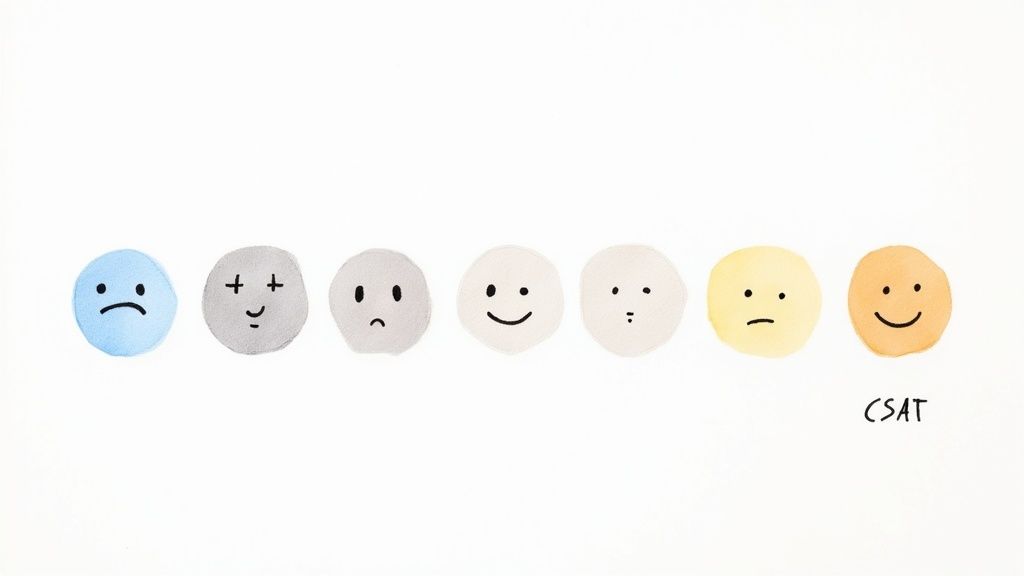
Customer Satisfaction (CSAT) is a fundamental metric used to gauge a customer's happiness with a specific interaction, product, or service. It directly asks, "How satisfied were you with [your recent purchase/customer support call/product delivery]?" This is an essential survey questions sample for customer satisfaction because it provides immediate, granular feedback on distinct parts of the customer journey.

Responses are typically collected on a 5-point scale (from "Very Unsatisfied" to "Very Satisfied"). The final CSAT score is calculated as the percentage of respondents who are satisfied, meaning those who selected 4 ("Satisfied") or 5 ("Very Satisfied"). This gives you a clear, real-time pulse on customer sentiment.
Strategic Breakdown and Application
CSAT excels at measuring in-the-moment satisfaction, making it a powerful diagnostic tool. Unlike broader loyalty metrics, it pinpoints exactly which touchpoints are delighting or frustrating your customers. For example, a hotel might use CSAT at checkout to assess the stay, while an e-commerce site deploys it after delivery to evaluate the shipping process.
- When to Use: Immediately after specific interactions. This includes post-purchase, after a support ticket is closed, or following a feature update. The immediacy is key to capturing accurate feedback.
- Why It Works: Its simplicity and directness lead to high completion rates. The transactional nature of the question provides clear, actionable data tied to specific business operations, making it easy to identify areas for improvement.
Actionable Takeaways for Your Business
To get the most from your CSAT surveys, always deploy them within a few hours of the interaction while the experience is still fresh in the customer's mind. A crucial best practice is to include an open-ended follow-up question, especially for low scores, such as "How could we have improved your experience?".
Key Tactic: Don't just measure; diagnose. Monitor CSAT scores by department, support agent, or product line. This segmentation allows you to spot performance trends and address specific operational weaknesses before they impact your wider customer base.
By consistently acting on this feedback, you demonstrate a commitment to customer happiness that builds trust and loyalty. To start implementing effective feedback collection, you can explore CSAT solutions with GoodKudos. This proactive approach is vital for turning transactional satisfaction into long-term customer relationships.
3. Customer Effort Score (CES) Question Template
While satisfaction is important, the Customer Effort Score (CES) focuses on a different, equally critical aspect of the customer experience: ease. It measures how much effort a customer had to exert to get an issue resolved, a request fulfilled, or a product purchased. The core question is typically framed as, "To what extent do you agree or disagree with the following statement: The company made it easy for me to handle my issue." This is a vital survey questions sample for customer satisfaction as it directly correlates with customer loyalty.

Responses are usually captured on a 5 or 7-point scale ranging from "Strongly Disagree" to "Strongly Agree". The premise, popularised by research from CEB (now part of Gartner), is that reducing customer effort is a more reliable driver of loyalty than delighting them. High-effort experiences, like a complicated checkout process or a difficult support interaction, are primary drivers of customer churn.
Strategic Breakdown and Application
This question template excels because it pinpoints friction in the customer journey. A customer can be satisfied with the final outcome but frustrated by the process, and CES captures this crucial nuance. It shifts the focus from delighting customers to simply making their lives easier.
- When to Use: Deploy CES surveys immediately after specific interactions, such as after a customer support ticket is closed, following a purchase on your e-commerce site, or after a user completes an onboarding process.
- Why It Works: It is highly specific and transactional, providing clear, actionable feedback on a particular process. This allows businesses to identify and eliminate bottlenecks, directly improving the customer experience and fostering loyalty. For a deeper dive, you can explore CES strategies with GoodKudos.
Actionable Takeaways for Your Business
To get the most from CES, it is essential to ask a follow-up question to understand the 'why' behind the score, such as "What made this process difficult for you?". This qualitative data reveals the exact sources of friction.
Key Tactic: Focus your improvement efforts on reducing friction, not just chasing high satisfaction scores. Analyse high-effort feedback to identify patterns in your processes, systems, or staff training that need to be addressed.
By tracking CES at key touchpoints, you can create a seamless, low-effort experience that keeps customers coming back. Prioritising the removal of obstacles is a powerful strategy for retention. Ready to identify and eliminate friction points? GoodKudos offers the tools to implement effective CES surveys and enhance customer loyalty.
4. Rating Scale Question Template
Rating scale questions are a highly versatile tool in the world of customer feedback. They ask respondents to rate a specific attribute, experience, or statement on a predefined scale, often numerical (e.g., 1-5 or 1-10) or descriptive (e.g., Very Dissatisfied to Very Satisfied). This type of survey questions sample for customer satisfaction is fundamental for quantifying subjective opinions and attitudes across various touchpoints.
A common example is: "On a scale of 1-5, where 1 is 'Very Dissatisfied' and 5 is 'Very Satisfied', how would you rate your recent support experience?". These scales convert qualitative feelings into quantitative data, making it easy to analyse trends, compare results over time, and benchmark performance. They are the workhorse of many feedback strategies, from product reviews to service quality assessments.
Strategic Breakdown and Application
The strength of rating scales lies in their adaptability and specificity. Unlike a broad question like NPS which measures overall loyalty, rating scales allow you to dissect the customer experience into its core components. You can measure satisfaction with product features, service responsiveness, delivery speed, or website usability individually.
- When to Use: Use rating scales to evaluate specific interactions, product attributes, or service dimensions. They are perfect for post-purchase follow-ups, support ticket resolutions, or after a new feature launch to gather granular feedback.
- Why It Works: They provide clear, structured, and easily comparable data. By using a consistent scale across your organisation, you can create a standardised framework for measuring performance in different departments, helping to pinpoint specific areas for improvement.
Actionable Takeaways for Your Business
To get the most out of rating scales, consistency and clarity are paramount. Always use clear, unambiguous labels for your scale's endpoints (e.g., 'Very Difficult' to 'Very Easy') to ensure every respondent interprets the question the same way.
Key Tactic: Use an odd-numbered scale (like 1-5) if you want to allow for a neutral middle option. Conversely, use an even-numbered scale (like 1-4 or 1-6) to gently push respondents to decide whether their experience was more positive or negative, avoiding non-committal answers.
Combine rating scale questions with an open-ended follow-up, such as "Could you please tell us why you gave that rating?". This adds crucial context to the score, explaining the 'why' behind the 'what'. Acting on this combined insight is key to enhancing customer satisfaction. To build your own detailed surveys with versatile rating scales, GoodKudos offers the flexible tools you need.
5. Multiple-Choice Question Template
Multiple-choice questions are a foundational element of effective surveys, providing respondents with a set of predefined options. In customer satisfaction surveys, they are invaluable for pinpointing specific satisfaction drivers, product preferences, or demographic details. This structured approach simplifies data collection and analysis, making it a go-to survey questions sample for customer satisfaction.
By offering clear, distinct choices, you guide the respondent towards providing the exact information you need. For example, asking "Which of the following best describes your reason for choosing our service?" with options like 'Price', 'Features', 'Customer Support', or 'Reputation' yields quantifiable insights into your unique selling propositions.
Strategic Breakdown and Application
This question template excels at gathering specific, categorised data efficiently. Unlike open-ended questions which require manual analysis, multiple-choice answers can be automatically tallied and visualised, making it easy to spot trends and patterns in customer behaviour and preferences.
- When to Use: Use these questions to segment your audience (e.g., "How often do you use our product?"), identify friction points (e.g., "What was the primary issue you experienced?"), or understand the customer journey (e.g., "Which touchpoint was most important in your purchase decision?").
- Why It Works: It reduces respondent effort, which often leads to higher completion rates. The structured data is easy to analyse, allowing you to quickly translate feedback into business intelligence and strategic decisions.
Actionable Takeaways for Your Business
To maximise the effectiveness of multiple-choice questions, careful design is crucial. Ensure your options are comprehensive and mutually exclusive to avoid confusion. Randomising the order of answers can also help to minimise selection bias.
Key Tactic: Limit your options to between 5-7 choices to prevent decision fatigue. Always include an "Other (please specify)" or "Not applicable" option to capture responses that don't fit neatly into your predefined categories, ensuring your data is as accurate as possible.
By carefully crafting your questions and options, you gather clean, structured feedback that is easy to act upon. This allows you to make informed improvements to your products, services, and overall customer experience. To start building powerful, data-driven surveys, GoodKudos offers intuitive tools to create and analyse your results.
6. Open-Ended Question Template
While scaled questions provide valuable quantitative data, open-ended questions deliver the rich, qualitative context behind the numbers. They invite customers to express their thoughts in their own words, uncovering insights you might never have thought to ask about. A classic example is, "What is the primary reason for your score?" This is a critical survey questions sample for customer satisfaction for understanding the 'why' behind customer behaviour.
By asking questions like "What could we do to improve your experience?" or "Please describe what you liked most about our service," you open a direct channel to your customer's voice. These unrestricted answers can reveal specific pain points, highlight unexpected strengths, and provide authentic testimonials. They are essential for a complete picture of customer sentiment.
Strategic Breakdown and Application
This question template is your tool for discovery. It moves beyond simple satisfaction metrics to explore customer motivations, frustrations, and suggestions in detail. The unfiltered nature of the feedback is invaluable for product development, service improvements, and marketing strategy.
- When to Use: Place these questions after a quantitative rating (like CSAT or NPS) to understand the score. They are also powerful in post-purchase follow-ups or when exploring new feature ideas.
- Why It Works: They give customers a voice, making them feel heard and valued. The detailed responses can pinpoint precise issues or highlight what your team is doing exceptionally well, providing clear direction for action.
Actionable Takeaways for Your Business
To get the most from open-ended questions, be strategic. Avoid overwhelming customers; limit your survey to one or two well-phrased open-ended questions. Also, use inviting language like "We'd love to hear your thoughts on..." to encourage more detailed responses.
Key Tactic: Don't let qualitative data sit idle. Use text analytics tools to categorise feedback into themes like 'pricing', 'customer support', or 'product features'. This organises the feedback, revealing trends and priorities at a glance.
By analysing this feedback, you can identify recurring problems that need immediate attention or discover what truly delights your customers. This direct line to the customer's mind is a powerful driver for meaningful change. Ready to gather this deep feedback? GoodKudos helps you build surveys that combine quantitative scores with insightful open-ended questions.
7. Likert Scale Question Template
The Likert scale is a classic and highly reliable method for measuring attitudes or opinions. It asks respondents to specify their level of agreement or disagreement with a series of statements. Typically using a 5 or 7-point scale, responses range from 'Strongly Disagree' to 'Strongly Agree', providing nuanced insight into customer sentiment. This format is a versatile survey questions sample for customer satisfaction because it can be applied to almost any aspect of the customer journey.
For instance, you might ask customers to rate their agreement with the statement, "Our website is easy to navigate." The ordered response options allow you to quantify feelings that are otherwise subjective, making the data easy to analyse while still capturing degrees of satisfaction. This structure combines the simplicity of multiple-choice with the detail of a rating scale.
Strategic Breakdown and Application
The power of the Likert scale lies in its ability to measure the intensity of feeling. Unlike a simple yes/no question, it captures whether a customer feels strongly or only mildly about an issue. This granularity is crucial for prioritising improvements and understanding what truly drives customer loyalty. It provides a standardised way to measure perceptions across different features, services, or touchpoints.
- When to Use: Use Likert scales to assess specific aspects of your service, product features, or support interactions. They are ideal for measuring agreement with statements like, "The product met my expectations" or "Customer support resolved my issue quickly."
- Why It Works: The format is intuitive for respondents, leading to reliable data and high completion rates. It allows for sophisticated statistical analysis, enabling you to identify trends and correlations in customer feedback more effectively than with simpler question types.
Actionable Takeaways for Your Business
To get the most from Likert scale questions, ensure your statements are clear, specific, and unambiguous. It is also wise to include a mix of positively and negatively worded statements to prevent acquiescence bias, where respondents tend to agree with statements regardless of their content.
Key Tactic: Group related Likert scale questions together to form a "scale battery". This allows you to measure a broader concept, like overall product quality or support satisfaction, by combining the scores from several related statements, providing a more robust and reliable metric.
Always provide clear, balanced labels for each point on the scale, such as 'Strongly Agree', 'Agree', 'Neutral', 'Disagree', and 'Strongly Disagree'. This clarity ensures every respondent interprets the question in the same way. Ready to build detailed surveys that uncover deep insights? GoodKudos provides the tools to create and analyse effective Likert scale questions today.
8. Matrix Question Template
Matrix questions, also known as grid or table questions, are an efficient format for asking about several related items using the same set of response scales. This template presents questions in a grid, with different items or statements in the rows and response options in the columns. It is an essential survey questions sample for customer satisfaction for measuring satisfaction across multiple product features or service touchpoints in a compact way.
For instance, you might ask customers to rate their satisfaction with different aspects of your service (e.g., website, phone support, in-person service) on a scale from "Very Dissatisfied" to "Very Satisfied". This consolidates multiple questions into one, simplifying the user experience and reducing survey fatigue.
Strategic Breakdown and Application
This question template excels at gathering detailed feedback on various components of a single experience. By grouping related items, it allows respondents to evaluate and compare them easily, providing you with a clear, at-a-glance view of your strengths and weaknesses.
- When to Use: Use a matrix question when you need to assess multiple attributes of a product, service, or customer interaction. It is ideal for post-purchase feedback on product features (design, durability, value) or for evaluating different communication channels.
- Why It Works: Its efficiency leads to a better respondent experience and higher completion rates for longer question sets. The grid format makes it simple to analyse and visualise comparative data, helping to quickly identify specific areas needing improvement.
Actionable Takeaways for Your Business
To create an effective matrix question, clarity and conciseness are key. Keep the grid manageable and intuitive to prevent confusion and ensure accurate responses.
Key Tactic: Limit your grid to 5-7 rows and 3-5 columns to avoid overwhelming the user, especially on mobile devices. Ensure your row and column labels are clear, and the rating scale is consistent and logical across all items.
Analyse the results by looking for patterns. Are all your communication channels performing well except one? Is a specific product feature consistently rated lower than others? This focused feedback pinpoints exactly where you need to direct your improvement efforts. Ready to gather this kind of detailed feedback? GoodKudos provides flexible survey tools to build effective matrix questions today.
8 Customer Satisfaction Question Templates Compared
| Question Type | 🔄 Implementation Complexity | ⚡ Resource Requirements | 📊 Expected Outcomes | 💡 Ideal Use Cases | ⭐ Key Advantages |
|---|---|---|---|---|---|
| Net Promoter Score (NPS) Question Template | Low — single 0–10 item plus optional follow-up | Low — minimal design, basic segmentation & trend analysis | Predicts loyalty/growth; promoter/detractor segmentation (score -100 to +100) | Brand- or product‑level loyalty tracking and benchmarking | ⭐ Predictive of growth; simple; low respondent fatigue |
| Customer Satisfaction (CSAT) Question Template | Low — single 1–5/7 item per interaction | Low — quick deployments post‑transaction, basic analysis | Immediate satisfaction % (common benchmarks ~80%+) | Transactional feedback (checkout, support, delivery) | ⭐ Direct touchpoint measure; fast actionable feedback |
| Customer Effort Score (CES) Question Template | Low–Medium — single effort-focused item; requires process context | Medium — needs journey mapping and follow-up probes | Measures ease of task completion; strong retention predictor | Onboarding, support flows, multi-step processes | ⭐ Identifies friction; linked to retention and lower churn |
| Rating Scale Question Template | Low — flexible numerical/visual scales across items | Low–Medium — consistent anchors and scale design | Quantitative measures across dimensions (satisfaction, quality, frequency) | Broad surveys measuring multiple constructs | ⭐ Highly versatile; easy statistical analysis |
| Multiple-Choice Question Template | Low — predefined options; careful option design required | Low — easy to collect and tabulate; needs good option crafting | Categorical insights on drivers, behavior, demographics | Driver identification, frequency, reason selection | ⭐ Clean, comparable data; efficient segmentation |
| Open-Ended Question Template | Medium–High — free‑text prompts; harder to standardize | High — manual coding or NLP/text‑analytics tools needed | Rich qualitative context, reasons, new themes and sentiment | Follow-ups to low scores; discovery and feature insight | ⭐ Deep context and authentic customer voice |
| Likert Scale Question Template | Low–Medium — multiple agree/disagree statements | Medium — item construction and composite scoring | Degree of agreement; reliable attitudinal measurement | Attitudinal surveys, composite indexes, perception studies | ⭐ Well‑validated; good for composite scores and trends |
| Matrix Question Template | Medium — grid of related items; attention to layout/usability | Medium — needs mobile testing and clear labeling | Comparative ratings across attributes or channels | Multi‑attribute comparisons (touchpoints, features, channels) | ⭐ Efficient for many related items; easy cross‑comparison |
From Feedback to Fortune: Activating Your Customer Insights
You have now explored a comprehensive toolkit of survey questions sample for customer satisfaction, moving from the broad strokes of Net Promoter Score to the granular detail of open-ended feedback. We have delved into the strategic applications of CSAT, CES, Likert scales, and more, demonstrating that the power of a survey lies not just in the question itself, but in its context, timing, and the actions it inspires. The journey from simply asking a question to truly understanding your customer is the bedrock of sustainable growth, customer loyalty, and a resilient brand reputation.
The key takeaway is this: a well-crafted survey is a conversation starter, not a final exam. Each response is a piece of a larger puzzle, offering you a direct line into your customer's experience. Whether you're a freelancer aiming to refine your service delivery, an e-commerce store optimising the checkout process, or a nonprofit seeking to better serve its community, the insights gathered are invaluable. They are the signposts that guide your strategic decisions, helping you to identify friction points, celebrate successes, and innovate with confidence.
Turning Insights into Actionable Strategy
Mastering the art of the customer satisfaction survey means moving beyond data collection and into the realm of data activation. Here are the crucial next steps to transform your survey results into measurable improvements:
- Segment Your Feedback: Don't treat all responses as a single monolithic block. Analyse feedback based on customer demographics, purchase history, or their stage in the customer journey. This will reveal nuanced patterns and allow for more targeted interventions.
- Close the Loop: Actively follow up with respondents. Thank customers for their time, especially those who provide detailed open-ended feedback. For those who report a negative experience (Detractors in NPS), a prompt, personal follow-up can often turn a poor experience into a story of exceptional customer service.
- Share Insights Internally: Customer feedback should not live in a silo. Share key findings with all relevant teams, from product development to marketing and sales. This ensures everyone in your organisation has a clear, unified understanding of the customer's perspective.
- Prioritise and Implement: You cannot fix everything at once. Use the data to identify the highest-impact changes. A high-effort process (flagged by CES) that affects many customers should take priority over a minor issue reported by a few.
The ultimate goal is to create a continuous feedback loop where customer insights directly fuel business evolution. This proactive approach doesn't just solve problems; it builds a culture of customer-centricity that becomes your most powerful competitive advantage. By consistently listening and responding, you demonstrate to your customers that their voice matters, fostering a deeper sense of connection and loyalty. To put these strategies into practice, visit GoodKudos and start building your customer-centric feedback program today.
Ready to transform your positive feedback into your most compelling marketing asset? While surveys help you gather crucial data, Good Kudos helps you showcase the brilliant results. Seamlessly collect your best customer testimonials from surveys and emails, and display them on a beautiful, trust-building 'Kudos Wall' on your website. Start your free account at Good Kudos today and turn customer satisfaction into powerful social proof.