
How Do I Write a Testimonial That Converts
Writing a great testimonial is all about telling your story. It’s not about crafting the perfect sales pitch; it’s about sharing a genuine experience to help someone else who's standing where you once were. You're basically highlighting the problem you had, explaining how a product or service fixed it, and sharing the brilliant results you got. Think of it as a short, authentic success story.
Why Authentic Testimonials Actually Matter

Before you even start writing, it’s worth understanding just how valuable your story is. We live in a world saturated with slick corporate advertising, and people are, quite rightly, a bit cynical. They don't want to hear what a company says about itself; they want to hear from real people.
That's where you come in. Your personal experience is the proof they're looking for. It cuts through all the marketing fluff and creates a real human connection. When you share your honest thoughts, you're not just leaving feedback – you're guiding someone's next big decision.
The Power of Social Proof
There's a name for this: social proof. It’s the simple idea that we look to others' actions and experiences to figure out our own. It’s why we read reviews before booking a restaurant or check ratings before downloading an app. Your testimonial is one of the most powerful forms of social proof because it comes from a real, unbiased source.
This is especially true in the UK, where recommendations from peers now carry huge weight. In fact, one UK consumer survey found that over 70% of UK consumers trust testimonials more than they trust what a company says about itself. That's a massive shift in how people make buying decisions.
Building Trust Through Your Story
A real, heartfelt testimonial does so much more than just sell something; it builds a foundation of trust. It shows potential customers that someone just like them invested their own time and money and came out the other side with a positive result. That’s far more persuasive than any shiny advertisement.
Your unique voice is a vital asset for any business you support. By sharing your journey, you offer a transparent look at the value a product or service delivers, helping to build a community around a brand.
Ultimately, writing a testimonial is your chance to help create a more honest marketplace. It's why platforms like Good Kudos exist—they make it easy for businesses to collect these genuine stories, turning individual experiences into a powerful way to build credibility and earn real loyalty.
Preparing to Write Your Impactful Story

Before you even think about putting pen to paper (or fingers to keyboard), take a moment. The best testimonials aren't just written; they’re reflected upon. This isn't about just saying something nice – it's about telling a miniature story.
A great story needs a clear beginning, middle, and end. Start by thinking about what life or business was like before you found this solution. What was the specific headache you were dealing with? Getting clear on that initial challenge sets the stage for a much more powerful narrative. It’s what makes your story relatable.
Pinpoint Your Turning Point
Now for the magic moment. Every great story has a turning point—that "aha!" moment where you realised, "Wow, this is actually working." This is the core of your testimonial.
Was it a specific feature that saved you hours of tedious work? A piece of advice that completely shifted your perspective? Or maybe it was a moment of incredible customer service that made you feel truly valued.
For example, let's say you were drowning in back-and-forth emails trying to manage client feedback. Your "aha!" moment could have been the first time a customer effortlessly sent you a video review, cutting out the entire complicated chain. Detailing that specific turning point is what gives your story weight and believability.
The most persuasive testimonials don't just state that a product is good; they show how it solved a real-world problem. By defining your 'before' state and identifying your 'aha!' moment, you create a relatable journey for potential customers.
To get your thoughts flowing, just ask yourself a few simple questions:
- What was the biggest frustration I had before this? (This nails down the problem.)
- Why did I choose this solution over others? (This highlights what makes it special.)
- What was the first real result I noticed? (This provides the proof.)
Running through these points helps make sure your feedback is detailed, authentic, and genuinely helpful. And for any businesses out there looking to get these kinds of stories from their own customers, platforms like Good Kudos make it incredibly simple to guide people through this exact process.
Bringing Your Experience to Life with Detail
Alright, you’ve got your main points mapped out. Now for the fun part: turning those bullet points into a story that actually connects with people.
The real secret to a testimonial that sticks? The details. Vague praise like "it was a great service" is nice, but it’s completely forgettable. It lacks the substance and feeling that makes someone else sit up and listen.
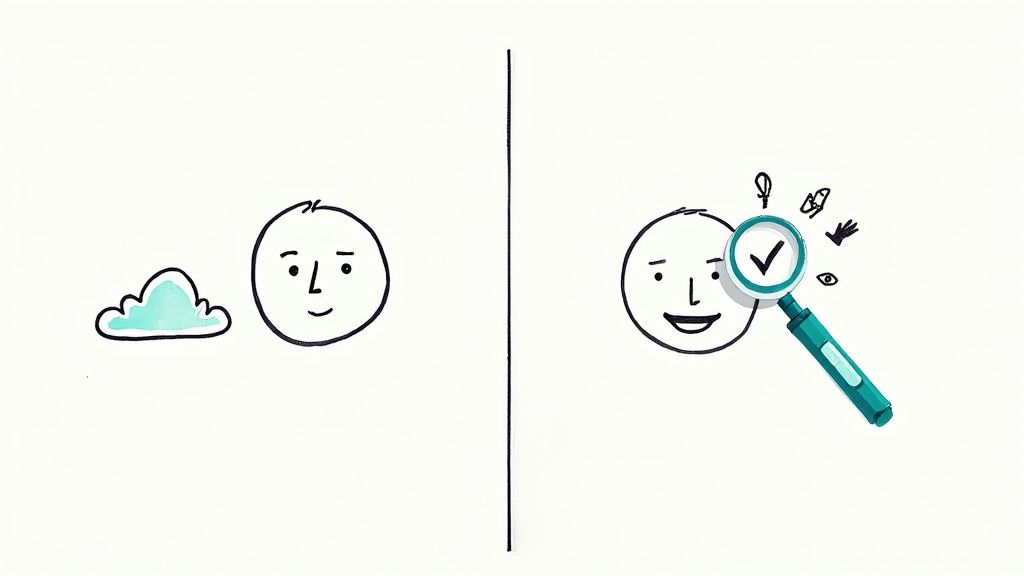
To make your story resonate, you need to paint a picture. Think tangible and emotional. Instead of just saying a product saved you time, show us what you did with that extra time. Did you finally get to leave the office early and make it to your kid's football game? That's a real-life moment people understand and connect with.
The Power of the Before-and-After Story
One of the most powerful ways to frame your experience is with a simple "before-and-after" narrative. It’s a classic storytelling structure for a reason—it makes the value of what you're talking about instantly clear.
Start by describing the problem you were facing—the "before." Don't be afraid to get specific about the frustration or the bottleneck. Then, introduce the product or service as the hero of the story, the thing that created the "after." This contrast is what gives your testimonial its punch.
Think of yourself as a guide. You're showing someone who is stuck in your 'before' state the path to their own 'after.' Your specific details are the signposts that make them believe the journey is possible for them, too.
For example, a freelance designer might share something like this:
- Before: "I was losing nearly five hours a week just chasing clients for feedback. It was a total drain on my creativity and, honestly, my bank account."
- After: "Now, I get clear, consolidated feedback in minutes. That’s five extra hours I can pour into actual design work, which has already helped me land two new projects this month."
See the difference? That's a story, not just a review.
The table below shows just how much more compelling your feedback can be when you swap out vague compliments for specific, impactful details.
Transforming Vague Praise into Specific Impact
| Generic Statement | Specific & Persuasive Alternative |
|---|---|
| "The customer service was great." | "I had an issue on a Sunday, and their support team responded in 15 minutes. Alex walked me through the fix and I was back online immediately." |
| "This software saved us time." | "We used to spend 10 hours a month on manual data entry. With this tool, that process is now automated and takes less than an hour." |
| "I'm really happy with the results." | "In the three months since we started, our website traffic has increased by 40%, and we've seen a 15% lift in qualified leads." |
| "The course was very helpful." | "The module on email marketing gave me a framework that helped me double my open rates from 22% to 45% in my first campaign." |
Moving from the generic to the specific is what transforms a simple "thanks" into a powerful piece of social proof that genuinely helps others make a decision.
Choosing Words That Add Colour
The words you choose are your paintbrush. Strong, action-oriented verbs and specific adjectives make your story feel more genuine and less like a canned response. They add a bit of your own personality.
Instead of saying a report was "good," you could say it was "insightful," "clear," or "actionable." Each of those words carries far more weight and tells the reader something specific. This is what helps potential customers truly picture themselves getting similar results—and that’s the whole point of a great testimonial.
Ready to make collecting these detailed stories easier for your own business? Good Kudos provides a simple, effective platform for gathering authentic video and text testimonials. Start building your wall of social proof today at GoodKudos.com.
Structuring Your Testimonial for Readability
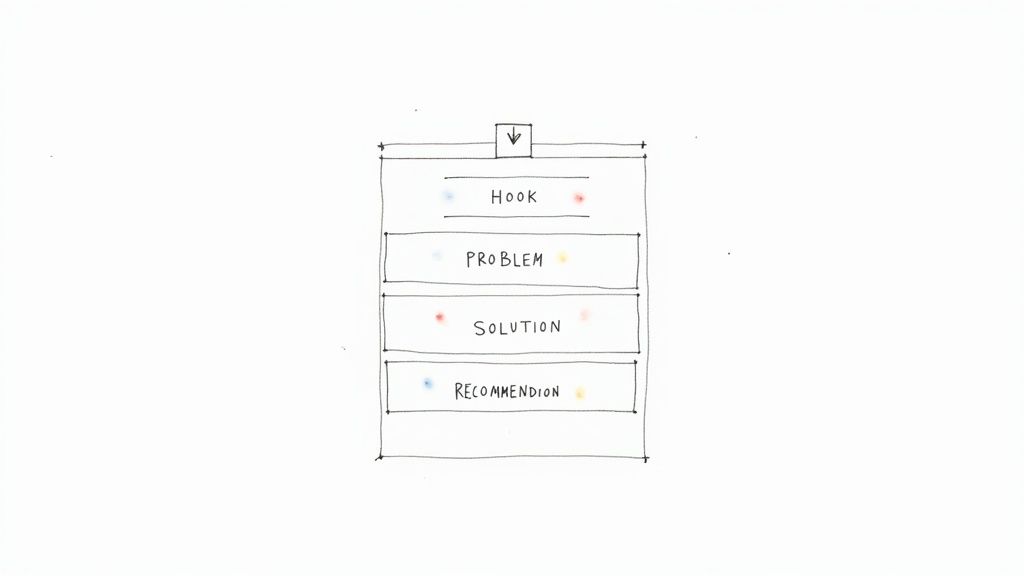
How you put your story together is just as important as the words you pick. A testimonial that’s a jumbled mess won’t land, no matter how great the outcome was. The goal is to make it effortless for someone to follow along, so your key points really hit home.
The best way to kick things off? A powerful hook. This isn’t the time to be subtle. Lead with your most surprising result or the biggest headache you were dealing with before you found your solution. Its only job is to get someone to read the next sentence, pulling them in from a casual skim.
Once you’ve got their attention, get right into the problem you were trying to fix. This is where you build that all-important connection, because odds are, your potential customers are stuck in a similar boat. Don’t just state the problem; explain the frustration it caused.
A Framework That Just Works: Problem-Agitate-Solution
There's a classic storytelling framework that’s perfect for this: the Problem-Agitate-Solution (P-A-S) model. It’s simple, effective, and guides the reader on a journey that makes perfect sense, both logically and emotionally.
Here’s how it breaks down:
- Problem: Start with the core challenge. Something like, "Keeping track of feedback from different clients was a total nightmare."
- Agitate: Now, pour a little salt on the wound. Explain why it was such a problem. "We were drowning in endless email chains, which led to missed deadlines and constant confusion."
- Solution: This is where you introduce the hero of the story. "Then we found [Product Name], which put all our communication into one clean, simple dashboard."
This little model creates a natural narrative. It builds tension by exploring the problem, then gives a satisfying release with the solution. It makes the final result feel that much more impressive.
Stick the Landing with a Clear Recommendation
After you’ve walked them through the solution, it’s time to wrap it up. End with a clear, enthusiastic recommendation—your final stamp of approval. Now isn’t the time for maybes. A direct statement packs a real punch.
Think something like, "I’d wholeheartedly recommend this to any freelancer who wants to get their time back."
Knowing who you’re talking to can make your recommendation even stronger. For instance, a recent UK government survey found that while overall customer satisfaction was 87%, it jumped to 93% for older customers. This tells us that testimonials speaking to specific needs can be incredibly persuasive. You can see the full customer experience survey summary for more details.
By structuring your testimonial as a mini-story—from problem to solution to a solid recommendation—you create something that’s not just readable, but genuinely persuasive.
Of course, getting your customers to write these perfectly structured stories can be a challenge. That's where a dedicated platform can change the game. Good Kudos guides your customers through a simple process, making it easy for them to share their experiences and for you to get powerful, readable testimonials every single time. Check out how it works over at GoodKudos.com.
A Quick Polish Before You Hit ‘Send’
You’ve got your story down. Now, before you share it, a quick once-over can take it from good to absolutely brilliant. This isn't about rewriting everything; it's just a final check to make sure your message hits home.
One of the best tricks in the book is to read your testimonial out loud. Seriously, try it. You'll instantly catch any clunky phrases or sentences that just don't sound like you. Trim out any words that don’t add value – a shorter, punchier message always lands better.
Make sure the tone feels authentic and positive, reflecting your true experience. And finally, if you're comfortable with it, add your name and maybe your job title. That one small detail adds a massive dose of credibility and helps others trust your story.
A quick edit makes sure your main point shines through without any distractions. In the world of testimonials, clarity and honesty are your best friends.
For businesses looking to make collecting polished feedback this easy, see how GoodKudos can help you gather powerful stories at goodkudos.com.
Still Got Questions About Writing Testimonials?
Even with the best of intentions, staring at a blank page can feel a little daunting when you’re asked for a testimonial. Let's clear up a few of the common sticking points so you can share your story with confidence.
How Long Should It Be?
This is probably the number one question I hear. While there's no magic word count, the sweet spot is usually between 50 and 100 words. That’s just enough room to pack in the important details without losing the reader's attention. Think of it as a powerful, bite-sized story that someone can easily scan while scrolling.
What If I Don't Have a Dramatic Story?
Another common hurdle is feeling like you don’t have a specific, mind-blowing story to tell, even though you loved the service. Don't worry about it. In this case, just focus on the main benefit or the overall feeling you were left with.
A simple, heartfelt line like, "The team’s support always makes me feel valued and heard," is incredibly powerful. It speaks directly to a core emotional outcome, which is often more persuasive than a long, complicated story.
Should I Add My Name and Photo?
People often wonder if they should include personal details. My advice is to only ever share what you’re comfortable with, but adding a name—even just a first name and last initial—and a photo can seriously boost a testimonial's credibility. It shows there’s a real person behind the praise.
This kind of authenticity is a game-changer, especially in the UK market. Consider this: customer satisfaction for services like HMRC is around 79.4%, and nearly half of all consumers have experienced poor service somewhere along the line. A genuine, positive story doesn't just get noticed; it cuts through the noise. It provides the social proof that helps other people feel confident they’re making the right choice. You can dig into more of these UK customer satisfaction findings if you're curious.
When it comes down to it, the goal is simple: be honest, be as specific as you can, and focus on the value you received. Your genuine experience is the most persuasive tool there is.
Ready to streamline how you collect these powerful stories for your own business? Good Kudos makes it incredibly easy for your customers to share their feedback, turning their positive experiences into your most valuable marketing asset. Start gathering authentic testimonials in minutes at https://goodkudos.com.