remove bad review google: UK guide to removal
Trying to get a bad review taken down from Google can feel like a losing battle. And honestly? A lot of the time, it is. The hard truth is that having a negative review removed is pretty rare unless it’s a clear-cut violation of Google's specific content policies.
Let’s get real about what you can expect and shift the focus from chasing deletions to building a review strategy that’s actually effective. A proactive reputation is your best defence, and services like Good Kudos can help you build it.
The Reality of Removing Bad Google Reviews

It’s natural to want every negative comment gone, but Google’s entire system is built to protect the customer's right to share their experience. This means a review that simply expresses genuine dissatisfaction—even if you completely disagree with their version of events—is almost certainly going to stay up.
This isn't just a Google thing. Regulations here in the UK are designed to keep things transparent, and they seriously limit a business's ability to just delete feedback they don't like. That's why spending all your energy trying to remove one review is often a poor use of time compared to building a stronger, more positive online presence.
Why Is It So Hard to Get a Review Removed?
When you flag a review, the odds are stacked against you. In fact, one recent survey found that only 15% of UK businesses actually succeeded in getting a negative review removed through Google's official process. You can dig into more data on UK business review management to see just how tough it is.
So, what makes it so difficult? It usually comes down to a few things:
- You carry the burden of proof. It’s on you to make a convincing case that the review breaks a specific rule.
- Subjectivity isn't a violation. A customer saying they had a "terrible experience" is just their opinion. It’s not harassment or spam, so it stays.
- You have to get past the bots. Your flag first goes through an automated filter. Even if it gets escalated to a human, they have to interpret the policies very strictly.
To make it clearer, here’s a quick rundown of what Google considers a valid reason for removal versus what they'll almost always reject.
Valid vs Invalid Reasons for Google Review Removal
| Valid Reason for Removal (Policy Violation) | Invalid Reason for Removal (Will Be Rejected) |
|---|---|
| Spam, fake content, or posted by a bot | You disagree with the customer’s opinion or version of events |
| Hate speech, harassment, or threats | The reviewer only left a star rating with no text |
| Off-topic or not related to the experience with your business | You think the review is unfair or overly harsh |
| Includes personal information (phone number, address) | The customer was difficult or rude during their visit |
| Clear conflict of interest (e.g., posted by a competitor or ex-employee) | The issue was resolved after the review was posted |
This table isn't exhaustive, but it gives you a good idea of the high bar you need to clear. Unless a review falls squarely into that first column, your flag is unlikely to succeed.
The most crucial takeaway is this: your time is better spent building a proactive reputation strategy rather than reacting to every negative comment. A steady stream of positive feedback will naturally diminish the impact of any single bad review.
For businesses ready to build a powerful and resilient online reputation, a dedicated platform can make all the difference. Good Kudos helps you effortlessly collect and showcase positive testimonials, ensuring your best customers define your brand.
Spotting Reviews That Actually Break Google's Rules
First things first, let's get one thing straight. Google isn't going to remove a review just because it stings or you don't agree with it. Before you can even think about getting a negative review taken down, you have to be certain it actually violates one of Google's specific policies. The burden of proof is on you.
Think of it this way. A customer leaving a review that says, "The service was slow and my coffee was cold," is just sharing their opinion. It’s negative, sure, but it’s their experience. Annoying, but not a policy violation.
But a review that claims, "The barista is a thief and stole my wallet!"—that's a different story entirely. That’s a serious, potentially defamatory accusation that crosses the line from subjective opinion to a harmful, factually questionable statement. That’s the kind of thing you can flag.
Common Policy Violations to Keep an Eye On
To have any chance of success, you need to build a solid case by matching the review to one of Google's prohibited content categories. Get familiar with these common red flags, because this is what the moderators are looking for:
- Conflict of Interest: This is a big one. The review comes from a current or former employee, a direct competitor, or someone who was paid to leave a fake review. A classic example is the rival café owner down the street leaving a one-star review on your profile without ever setting foot in your shop. That's a clear conflict of interest.
- Harassment or Hate Speech: This is when a review gets personal and nasty. It might contain direct threats, personal attacks, or discriminatory language aimed at you or your staff based on things like race, religion, or gender. There's zero tolerance for this.
- Off-Topic Content: The review has absolutely nothing to do with your business. It might be a random political rant, a personal story that's completely irrelevant, or a comment that was clearly meant for a different business.
A common mistake I see is business owners flagging a review simply for being "unfair." Google's moderators don't care about what's fair; they care about what breaks the rules. Your only shot is to pinpoint the exact policy the review violates.
Proving a violation is your only direct path to getting a review removed. If you can't find a clear-cut breach of policy, you're better off not wasting your energy trying.
For those reviews that are negative but legitimate, your best defence is a good offence. Shift your focus to drowning out the negativity by actively collecting more positive feedback. A streamlined service like Good Kudos can be a game-changer here, helping you build a stronger, more balanced online reputation that speaks for itself.
How to Flag a Review for Removal
Alright, so you’ve found a review that’s a clear-cut violation of Google’s policies. Now it’s time to flag it and bring it to their attention. Think of flagging as your direct line to Google’s moderators. Making a clear, concise case is the only way you stand a chance of getting it taken down.
The process itself is refreshingly simple. Just head over to your Google Business Profile and pull up the specific review you want to report.
You'll see three little vertical dots next to the reviewer's name. Give those a click, and a small menu will pop up. From there, just select "Report review" to get the ball rolling.
Choosing the Right Violation
This next part is where you need to be precise. After you click "Report review," Google will show you a list of possible policy violations. Your job is to pick the one that fits the situation perfectly.
This is, without a doubt, the most important step. If you get it wrong, your report will likely be dead on arrival.
For instance, if a disgruntled ex-employee leaves a nasty one-star rant, the correct violation is "Conflict of interest," not "Harassment." If the review includes private details like a phone number, you’d choose the option for private information. Be specific and be honest.
This infographic breaks down the basic workflow for spotting and flagging a review that crosses the line.
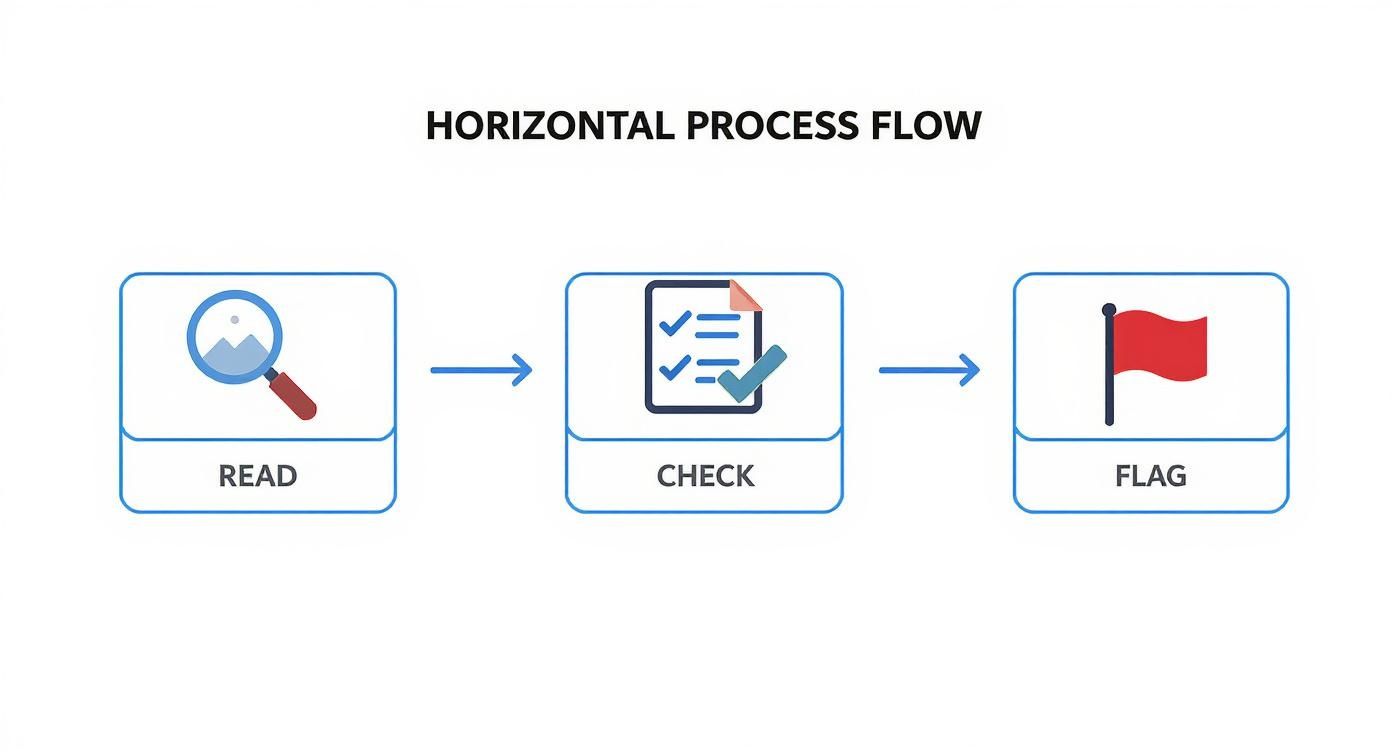
As you can see, a successful flag isn't just one quick click. It starts with careful analysis, followed by a very specific report. Once you've submitted it, you can check its status using Google's Review Management Tool. Just know that this isn't an overnight thing—it can take days, sometimes even weeks, and you aren't guaranteed to get a response.
Key Takeaway: The success of your removal request hinges on correctly identifying and reporting the specific policy violation. A vague or incorrect report will almost certainly be dismissed by Google’s automated systems and human moderators.
While you're waiting on Google, it’s smart to focus on what you can control. The best long-term defence against a bad review is a flood of good ones. Platforms like Good Kudos are brilliant for this, helping you systematically gather genuine testimonials to make sure your online reputation stays strong, no matter what.
What to Do When Google Rejects Your Removal Request
It’s incredibly frustrating. You flag a review that clearly breaks the rules, wait for Google to take action, and then get that dreaded notification: "Not a violation of our policies." It’s a common story, but it doesn't have to be the end of it. Your first move is to use Google’s one-time appeal process.
This isn’t just a do-over. The appeal is your chance to build a much stronger case. Don’t just re-submit the same complaint; give them more context. For instance, if you originally flagged a review for being off-topic, your appeal should spell out exactly why.
You could add details like, "This review talks about a delivery service our restaurant doesn't offer, and even mentions a staff member named 'John' who has never worked here. We believe this was meant for another business." The more specific you are, the harder it is for them to ignore.
Escalating Your Case
So, what happens when even the appeal fails? This is where you have to think beyond Google’s standard support channels. Frankly, their first line of defence isn't always equipped to handle serious situations, especially reviews containing damaging and completely false accusations.
In the UK, a written statement that is false and causes serious harm to a business's reputation can be considered libel. Knowing where that line is can be critical for deciding what to do next.
Before you go any further, you need to get your evidence in order. Meticulously document everything. Take clear, dated screenshots of the review itself and all your communication with Google. This creates a paper trail that is absolutely essential if you decide to get legal advice.
Seeking Legal Counsel
If the review crosses the line into genuine defamation, it might be time to bring in a solicitor. Don't just go to any firm; find one that specialises in online reputation and defamation law in the UK. They can look at your documentation and advise you on the best course of action, whether that’s sending a formal legal takedown notice to Google’s legal team or pursuing action against the reviewer directly.
Navigating this can be tough, but you don't have to manage your reputation alone. For proactive support, platforms like Good Kudos can help you build a stronger online presence. By consistently gathering positive feedback, you can protect your brand and make sure one bad review doesn't define you.
Mastering Your Response to Negative Feedback
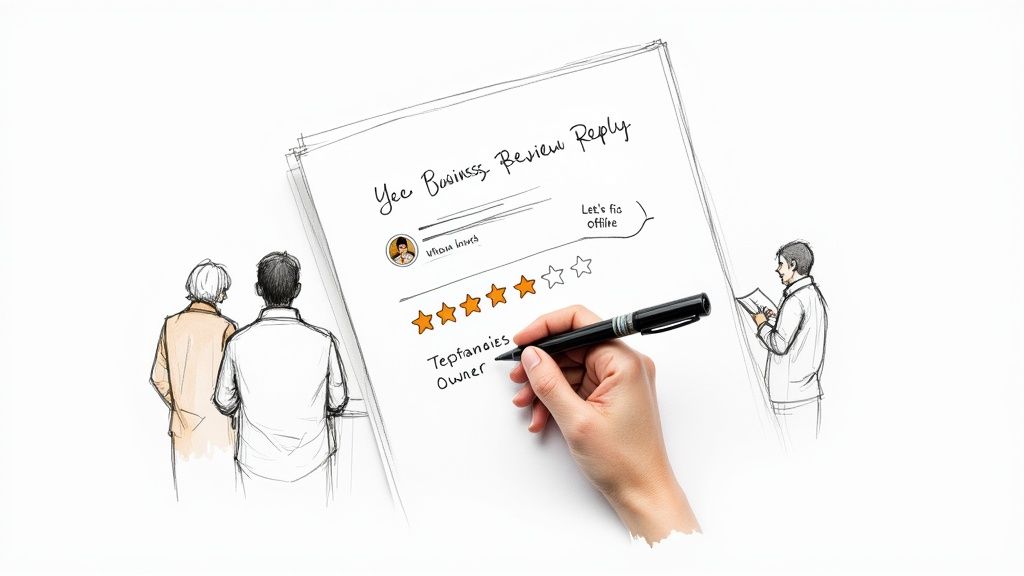
Let's face it: most negative reviews are here to stay. Once you accept that, you realise your public response isn't just damage control—it's your single most powerful marketing tool in this situation. A thoughtful reply can completely reframe a bad experience, turning it into a public display of your commitment to customer service. It shows everyone watching how you handle the tough stuff.
The goal here isn't to win an argument or prove the reviewer wrong. Your real audience is every potential customer who comes after them. You’re showing them that you listen, you care, and you take responsibility when things don’t go perfectly.
Ignoring feedback can be costly. Research focused on UK businesses shows that just one negative review can cause a 22% drop in customer engagement. But here's the flip side: that same study found businesses that consistently respond see a 15% improvement in customer perception. It proves that while you can't always remove a bad review, you can absolutely soften the blow. You can dive into the impact of online reviews and see the full data for yourself.
The Anatomy of a Perfect Response
Crafting the right reply is an art, but it’s one you can learn. The key is to stay professional, show some empathy, and always focus on a resolution.
- Acknowledge and Empathise: Always start by thanking them for their feedback and acknowledging their specific issue. A simple, "We're sorry to hear your experience didn't meet your expectations," shows you're actually listening.
- Don't Get Defensive: This is a big one. Avoid making excuses or getting into a public back-and-forth. Even if you think they’re wrong, arguing makes your business look unprofessional.
- Take It Offline: This is the most critical step. Offer to make it right by providing a direct point of contact, like an email address or a phone number, to resolve the issue privately.
This approach demonstrates real accountability and a genuine desire to fix the problem, which speaks volumes to prospective customers scrolling through your reviews.
The best responses are prompt, polite, and personal. They show a human behind the business, not a faceless corporation. This simple act builds trust far more effectively than a perfect five-star record ever could.
Getting this right every single time can be a real challenge, which is why many businesses turn to reputation management tools. For expert help crafting perfect responses and proactively building a positive online presence, a platform like GoodKudos can manage the entire process for you.
Do's and Don'ts of Responding to a Bad Review
When a negative review lands, your first instinct might be to react emotionally. Instead, take a breath and use this checklist to craft a response that protects—and even enhances—your brand's reputation.
| Do | Don't |
|---|---|
| Respond promptly. Aim for within 24 hours to show you're attentive. | Get into a public argument. It never looks good. |
| Address the reviewer by name. A personal touch goes a long way. | Make excuses or blame the customer. Take ownership, even if it's just of their feeling. |
| Thank them for their feedback. Show you value their input, good or bad. | Use a generic, copy-paste response. People can spot a template a mile away. |
| Acknowledge their specific concerns. This proves you've read and understood the review. | Ignore the review. Silence can be interpreted as guilt or indifference. |
| Apologise sincerely for their poor experience. Empathy is key. | Offer discounts or freebies publicly. This can encourage fraudulent complaints. |
| Offer to take the conversation offline. Provide a direct contact to resolve the issue privately. | Violate their privacy. Never share personal details about their purchase or visit. |
Following these simple rules turns a potentially damaging review into an opportunity to showcase your professionalism and customer-first attitude. It's not about being perfect; it's about how you handle things when they aren't.
Proactively Building a Positive Reputation
While knowing how to get a bad review off Google is a handy skill, it’s playing defence. The real winning strategy? Going on the offence. The most powerful way to neutralise a negative review is to simply bury it under a flood of positive ones. It's about shifting from a reactive panic to a proactive plan.
Instead of holding your breath and waiting for criticism, you need a system for actively encouraging your happiest customers to share their stories. This doesn't have to be a huge, complicated effort. The goal is to make leaving feedback ridiculously easy right at the peak of their satisfaction.
Seizing the Right Moment
Timing is everything. You want to pop the question when the great experience is still fresh in their mind, not a week later when the glow has faded.
Here are a few simple, field-tested ways to do it:
- Automated Email Follow-ups: A day or two after a purchase, send a short, friendly email asking for their thoughts. Crucially, include a direct link straight to your Google review page to remove any friction.
- In-Person Prompts: After a fantastic chat in your shop or a successful support call, just ask. A simple, "We'd be so grateful if you could share your experience on Google" often works wonders.
- QR Codes: Put them everywhere—on receipts, business cards, or at your till. One quick scan takes a happy customer directly to the place they can sing your praises.
A steady stream of four and five-star reviews does more than just nudge your average rating upwards. It builds a powerful wall of social proof that makes any lone negative comment look like what it is—an outlier, not the norm.
Building this positive momentum can feel like another job on your to-do list, but it's the single most reliable way to safeguard your brand's credibility. For businesses that want to put this on autopilot, a dedicated testimonial platform like GoodKudos can automate the requests and showcase your best feedback without you lifting a finger.
Your Google Review Questions, Answered
When you're dealing with Google reviews day in and day out, you start to run into the same questions over and over. As a business owner in the UK, you need practical, no-fluff answers to cut through the noise.
Let’s tackle some of the most common queries we see.
How Long Does Google Take to Review a Flagged Review?
This is the million-dollar question, and unfortunately, there's no set answer. The process can take anywhere from a few days to several weeks. Google doesn’t give a guaranteed timeframe, which can be incredibly frustrating.
While you're waiting, that review is still live for everyone to see. This is exactly why having a professional, public response already posted is so critical. You can at least keep an eye on things by checking the status of your flag in your Google Business Profile’s review management tool.
Can I Sue Someone for a Bad Google Review in the UK?
Technically, yes. It is legally possible to sue for a defamatory review under UK libel law. But, and this is a big but, it's a very difficult, expensive, and complex path to take.
To have any chance of succeeding, you’d need to prove that the statements are completely false and have caused serious financial harm to your business. On top of that, you'll likely have to identify the reviewer, which isn't always easy. You should always speak with a solicitor who specialises in online defamation before even thinking about going down this road.
Taking legal action is a last resort, reserved for the most extreme cases of false and damaging claims. For almost all negative reviews, focusing on your public response and drowning it out with positive feedback is far more practical and cost-effective.
What Is the Best Way to Get More Positive Reviews?
The most effective and ethical way to get more good reviews is stunningly simple: just ask your happy customers.
Create a straightforward, systematic process that makes it easy for them to leave feedback. You could send automated follow-up emails with a direct review link, place QR codes at your checkout, or just ask in person right after a great conversation. The key is to make it a natural part of your customer experience.
Whatever you do, never offer incentives for reviews. It's a direct violation of Google's policies and can completely wreck your credibility if you get caught.
A proactive reputation strategy is always your best defence. For a streamlined approach that automates review requests and showcases your best feedback, see what Good Kudos can do for your business at https://goodkudos.com.